First Baptist Holland has a rich history, being chartered as a Baptist church in 1889. The church continues to add to this rich heritage year after year. For a document containing the historical details of the church history – including previous pastors, please contact the church office or, click on the tab here.
A History
A History of the First Baptist Church of Holland
Compiled by Jay R. Thomas
Updated and edited by Randall L. Evans
Our Beginnings
Many years ago in the small communities of our land, it was common for the different Christian denominations to share a house of worship because there were not enough people to support separate congregations. Each denomination would usually take one Saturday or Sunday of each month and hold their respective denominational worship service. Sunday Schools were typically organized after a model known as a “Union School.” Sunday School would be held every Sunday with members of all denominations who shared the building meeting together or in “union” with all the others. This was the condition in Holland during the late 1800’s with all denominations meeting in union with one another in a church building known as “the Carmeline Presbyterian church house.”
A man by the name of Wilkerson, who had been excluded for an unknown offense from the Post Oak Baptist Church a few miles to the north of Holland, came to Holland to organize a Baptist church in 1882. Though successful in establishing a congregation in the Carmeline Presbyterian church house, the organization was considered illegal because no one could be received as a member of a Baptist church who had been excluded from another Baptist church until he or she was first reinstated by the excluding church. Mr. Wilkerson would not make any concession to the Post Oak Baptist Church nor ask their forgiveness. Therefore, he remained excluded which made the organization of the “first” Baptist church in Holland illegal according to the church governance of the day. This first organization was called the Holland Baptist Church.
In the early part of 1889, about fifteen Baptists in Holland (participants in the Holland Baptist Church) determined to have a “legal” church and a building of their own. In February of that year they made out their bylaws, constitution, and articles faith. By March they were holding services once a month, though we have no record of where these services were held.
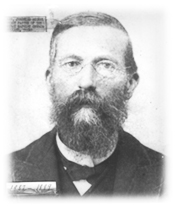
Rev. J. Mickle first pastor of FBCH
A few years prior to 1889 Reverend Jeremiah Mickle arrived in Holland to do ministerial work from Goldthwaite where he helped to start the First Baptist Church of Goldthwaite. Upon his arrival he was called to serve as pastor of two congregations—the Dyers Creek Baptist Church (located 3 miles west of Holland) and the Holland Baptist Church. Each congregation met one Sunday per month. Reverend Mickle had been a Union soldier during the Civil War and as a result of a battle injury had his left arm amputated below the elbow.
The newly organized “legal” church at Holland began to seek him as their pastor, but he initially declined their offer because he was pastor of the other organization in Holland. In the meantime, according to documents obtained from the Bell County Courthouse the new church secured a lot in the city of Holland and made preparations for a building. The property was purchased for the amount of $100.00 on November 28, 1889. Interestingly, the name of the church included in courthouse records was said to be the Second Baptist Church of Holland.
About the first of June of 1889 Reverend Mickle recalled that the church “plead so hard with him . . . that [he] consented to take the work.” According to Reverend Mickle’s account of his calling to his new church they “went in with our coats off, sleeves up and ready for business and took the name of the First Baptist Church of Holland because there was no one around who considered the old Baptist church of Holland a legal Baptist church.” (pg. 69) Charter members were Mr. and Mrs. T.A. Upshaw, Miss Mollie Upshaw, Miss Sallie Upshaw, Jeremiah Mickle, Harriet Mickle (Reverend Mickle’s wife), Billie Mickle, Susie Mickle, Miss Betty Taylor, and a few others whose names were not recorded.
Work had begun on the church building and about the second week in July of 1889 it was enclosed and temporary seating installed. About the last week of July, a four week revival was held in the 30 x 46 foot building. At the end of the revival, membership climbed from fifteen to eighty with many of the new members coming from Post Oak and Dyers Creek Baptist churches. Services began to be held twice a month with weekly prayer meetings and Sunday School, “which was strictly Baptist.”
Reverend Mickle noted in his memoirs that “in the latter part of October or the first of November 1891, the church house that we had succeeded in erecting was not yet completed.” Reverend Mickle was contemplating leaving Holland to return to the North and wanted to see the church completed and dedicated as his “last work.” The Baptist church at Belton donated the lead and oil to paint the building inside and out. Their greatest problem, however, was permanent seating for the church building.
Reverend Mickle said they “couldn’t raise money enough to seat it with opera chairs” as were popular in that day, but they did, however, learn of a church in Galveston that had recently installed opera chairs and had removed their old seats. They arranged to buy these seats which were “common [in] those days, straight back seats” for sixty-five dollars plus freight. They raised the money easily enough for the seats, but “it was a hard pinch when the seats came to raise the money to pay the freight as the freight was nearly as much as the seats cost.” So, the church borrowed the money to pay the freight and installed the seats. They could not afford to plaster the roof so they chose to “ceil with good boards.” And by the last of November 1891 the church was “enclosed, painted outside, ceiled inside and ready for the paint inside.” Work on the church concluded with Reverend Mickle painting the inside and personally having “grained the pews imitation of oak . . . and varnished.” Reverend Mickle recalls, “the bills that were still back [for the building] were provided for. Everything was straight and the house was completed.” So on December 8, 1891 the building was dedicated to the service of the Lord. Reverend Mickle resigned as pastor on that day and left the next day to do mission work in the state of Michigan. In Reverend Mickle’s memoir he stated that the day the building of the First Baptist Church of Holland was dedicated “was a great day . . . because [he] had made a success through the help of the Lord in establishing a church there upon a solid basis which the strongest, ablest minister in the county at Belton, N.V. Smith, said could not be done, and while he himself threw on the wet blankets all he could, he wasn’t able to stop it at all.”
His final worship sermon was preached at the First Baptist Church of Holland on that Sunday night December 8, 1891. Reverend Mickle recalled how “the house was filled to overflowing. After preaching an hour, [he] called the members forward . . . then [he] stepped down from the rostrum with them on the floor. [They] stood together and sang a hymn after which [they] all kneeled in prayer and [he] lead the prayer.” Reflecting on that experience, he stated, “I think I have never known in all my life an hour that was so full of joy of thanksgiving and of sorrow and regret as that was that we spent together in prayer.”
Working on ...
Working on a Building!
FBC Holland — 1929 to 1960
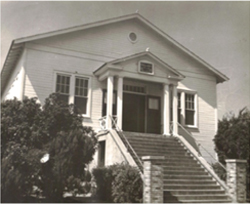
That original building was torn down in the period of 1908-1909 and a new building built on the ground where the present Holland water tower stands. A tabernacle was later erected to the side of the church building. This building was used until January of 1927 when soon after the morning service the building caught fire from the flue and burned. Worship services were then held in the tabernacle which had to be immediately walled and have a heater installed. The temporary location was used until a new building could be completed, which occurred in March of 1929. This building was erected across the street from the old building at the intersection of Lexington and Travis, facing north.
On Easter Sunday, the last Sunday in March of 1929, the church building was dedicated with Reverend Tilson Maynard, then Director of Missions at Tyler and former pastor of the First Baptist Church of Holland, preaching the sermon. A revival meeting began that same evening with the Reverend E. R. Couch of Baytown, also a former pastor, leading.
The 1929 building was used until 1960, when under the leadership of the Reverend Lloyd Elder, it was torn down and a brick building erected—this time with the front facing East toward Lexington Avenue. The dedication service for the 1960 building was held November 20, 1960. Dr. Arthur Tyson, President of Mary-Hardin Baylor College, brought the sermon and Reverend LaVern C. Cook, pastor of the Concord Baptist Church of Waco and a Holland native lead the dedication prayer. A note burning for this building and a homecoming service was held November 4, 1973. The church celebrated paying off its mortgage two years in advance.
FBC Holland — 1960 to 2009
Several expansions of the 1960 building were necessary because of the continued growth. A separate Fellowship Hall (which also contained the church’s nursery and provided a carport for the church’s van) was added in 1989. A three room education space was added between the 1960 building and the new Fellowship Hall in 1999. And finally, the church’s carport was enclosed to create two new Sunday School rooms in 2003.
FBC Holland — 2010 to Present
In 2000, under the leadership of Reverend Larry O’Neal, the church voted to enter another building project, this time with the intent to do so debt free. In 2001 ten acres were purchased on the northwest edge of Holland at the end of Dixie Drive. In 2005 utility service was established at the new location and excavation for the foundation pad began. In January 2006 the foundation for the new 25,000 square foot building was poured. Through God’s guiding hand the church was connected with a group of volunteers from Chilton Baptist Association in Alabama. The Chilton Baptist Builders, a group of more than eighty people, came to frame the new building. They arrived on June 16, 2006 and when they left on June 23, 2006 not only had the building been framed, all the roof trusses had been set as well. A second, smaller volunteer group comprised mainly of teenagers from Laguna Park Baptist Church arrived in July 2006 to help complete the lathing of the roof trusses in preparation for a metal roof, which was installed in October 2006. The new building was rocked with white stone during the summer of 2007. Interior work, such as air conditioning duct work, electrical wiring, and making needed adjustments for structural engineer approval were done between 2008 and 2009. Sheetrock was installed, taped, floated, and textured in March of 2010.
In June 2009, under the leadership of the Reverend Randy Evans, the church voted to sell the 1960 church complex in order to help finish the new building. The Holland Church of Christ purchased the building for $80,000.00. The final service was held in the 1960’s building on June 14, 2009. The church discontinued Sunday School and began meeting for worship in the Kuhlmann Civic Center in downtown Holland. In August 2010 the church offices were moved from their temporary location at 106 West Travis to the new building. In October 201o worship services began in the church’s new worship center. Sunday School began again in November 2010 with all classes being held in the North wing of the new building. Work continues on the new building.
The Pastor’s Home
Parsonage built in 1951
The church, in a regular conference held on October 11, 1939 gave the Board of Deacons “the authority to buy or not to buy a house and lot for a parsonage for our church whenever such property is offered for sale to this church.” The church also granted them the authority to “get the seller down to the lowest possible price.” No mention is made in the church records regarding the purchase of a parsonage and lot, but a recommendation was made and passed on September 30, 1942 that “the barn at the parsonage . . . be torn down and garage built” which indicates a parsonage was purchased sometime between 1939 and 1942. This parsonage was located at “Lot No. 6, of Block No. 7, of the Wilkirson Addition to the Town of Holland, Texas” which, according to an interview with Wilson H. “Boady” Johnson is one of the homes on Hogan Street across from the Holland Methodist Church. Interestingly, a motion was made and approved on September 19, 1943 to “give $50.00 toward a dining room suite [sic] for parsonage.”
Having built a new parsonage south of the church in 1951 the church voted at a business meeting held on April 6, 1952 to authorize the Deacon Body to sell the old parsonage to John R. Sloan for the amount of $2,500.00. The 1951 parsonage, a three bedroom, one bathroom home served many pastors well until on May 21, 1980 when the church was called to conference to consider a motion to build a new parsonage.
The original motion was presented to the church to vote on purchasing a lot and building a parsonage. A vote was taken by secret ballot and was a tie—sixteen “for” and sixteen “against.” A second vote was called to break the tie, but ended with the same results. A motion was then made to purchase the lot and that motion carried. A stalemate remained over building the parsonage, so a motion was made to wait thirty days to “think about it . . . and then bring it forth again.” That motion passed. On June 18, 1980 a special called business meeting was held to “vote on building a parsonage.” The motion was made to build the parsonage and the motion passed with 80% in favor. In March of 1981 the new, brick, three bedroom, and two bath parsonage was completed. It is located at the western edge of town along the highway to Salado. The 1951 parsonage was converted into Sunday School rooms and used until 1989 when it was sold and moved to make way for the new Fellowship Hall.
Women’s Ministry
The Women’s Missionary Union was organized in the early part of 1899 and was originally called the “Ladies Aid Society.” Mrs. C. W. Wilson was the first president, and Miss Mollie Vernon the first secretary, with Miss Bertie Wiseman serving as the first assistant secretary. From the year 1899 until the present there has been a woman’s ministry in the First Baptist Church with, at various times, all of the age-graded groups (i.e. Girls in Action, Mission Friends, Royal Ambassadors). Historically known as the Woman’s Missionary Union the group’s name has been changed in recent years to Baptist Women.
Men’s Ministry
Bell Baptist Association records reveal that Wayne Spinn, from 1979 until 1987, served as Brotherhood Director. The men, currently known as “Baptist Men,” meet once a month on the third Saturday for breakfast and are involved in ministries to the community and surrounding area.
Our Pastors
A Record of Our Pastors
The pastors of the church from 1889 until the present are listed below. Included are the names of interim pastors (when known) and are indicted by an *.